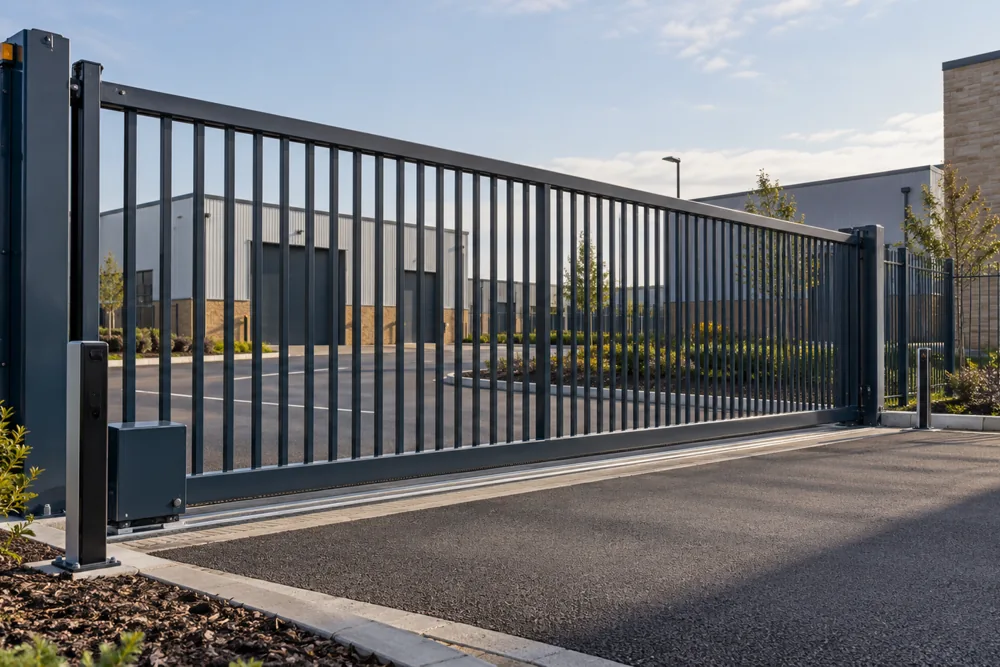
Plan The Entrance Before The Motor
An automatic gate controls a moving boundary in a space used by vehicles and people. Before selecting a motor or gate style, assess the entrance width, vehicle types, queuing space and pedestrian movement. A secure gate becomes a problem if deliveries block the road while waiting to enter.
Sliding and swing arrangements have different space requirements. A sliding gate needs a suitable runback area, while a swing gate needs clear movement arcs. Slopes, drainage, wind exposure and the condition of posts or foundations can affect what is practical at an existing commercial entrance.
Keep People Clear Of Movement
Powered-gate risks include crushing, trapping, impact and drawing-in points. The assessment must cover the complete gate and its surroundings, including hinges, posts, the ground and areas beside the opening. A photocell across the drive does not necessarily protect all of those locations.
Pedestrians should have a separate route where practical. Consider employees arriving on foot, delivery drivers leaving their cab and visitors unfamiliar with the entrance. Controls should be positioned so users can operate them without standing in the gate’s movement zone or reaching through moving parts.
Safety Duties And Technical Guidance
The Health and Safety Executive explains that powered gates must be safe for foreseeable use. For workplace equipment, duties can arise under the Workplace (Health, Safety and Welfare) Regulations 1992 and the Provision and Use of Work Equipment Regulations 1998. New powered assemblies also need assessment against applicable machinery supply requirements.
BS EN 12453 addresses safety in use of power-operated doors and gates. Ask the gate specialist which current standards apply and how risks, protective devices and testing will be documented. Read HSE powered-gate safety guidance for the principles behind safe installation and maintenance.
Survey And Installation Process
Begin with a physical survey and risk assessment. Establish gate geometry, foundation requirements, utilities, drainage and the expected duty cycle. Agree the access method, pedestrian provision and what happens when power or communications fail. Any civil works or electrical supply work should be identified in the proposal.
The installer then fits the mechanical assembly, drive, controls and specified safeguards. Commissioning should verify the safety functions and operating behaviour, with force testing where required by the design and applicable standard. The gate should not enter normal service with unresolved safety defects or unclear emergency release instructions.
Access Methods And System Interfaces
Commercial gates can use authorised credentials, an intercom or another agreed control method. The appropriate option depends on staff movements, delivery patterns and reception cover. A gate that is routinely left open because entry is awkward may not provide the intended boundary control.
Interfaces must preserve safety functions. Linking a gate to door entry or access control should not bypass protective devices. Remote operation requires particular care because the person issuing the command may not see the entrance. Agree the operating conditions and fault response before connecting systems.
What Affects Gate Costs
Gate size, material, opening type, ground conditions and the existing entrance structure all affect cost. Foundations, trenching, power supplies, drainage changes and traffic management may be substantial parts of the work. Safety devices and commissioning records belong in the scope rather than appearing as optional extras.
For an existing manual gate, automation is not always suitable without mechanical changes. Ask for an assessment of strength, stability, guarding and hinge condition before adding power. Compare a conversion with replacement when the existing assembly would need extensive repairs to operate safely.
Handover And Ongoing Care
Handover should provide operating and maintenance instructions, emergency release information, test records and the applicable conformity documentation. Identify who is authorised to use the manual release and where any required tools are kept. Staff need a clear process for taking unsafe equipment out of service.
Maintenance intervals should reflect usage, environment, manufacturer instructions and the risk assessment. Report impact damage, unusual movement or failed safeguards promptly. Do not keep cycling a gate that behaves unpredictably. Include your location and entrance type in an automatic gate enquiry to start a commercial assessment.
Your Questions Answered
Can An Existing Manual Gate Be Automated?
An existing manual gate may be suitable for automation after assessment of its structure, movement, foundations and surrounding hazards. Adding a motor changes the risks and creates responsibilities for the complete powered assembly. The specialist should explain any required rebuilding, guarding and safety devices before offering a conversion.
What Happens If An Automatic Gate Loses Power?
An automatic gate needs an agreed arrangement for power failure, which may include a manual release or a suitable backup supply. The correct approach depends on the gate and site risks. Users need accessible instructions and training, and the release procedure should be demonstrated before the entrance is handed over.