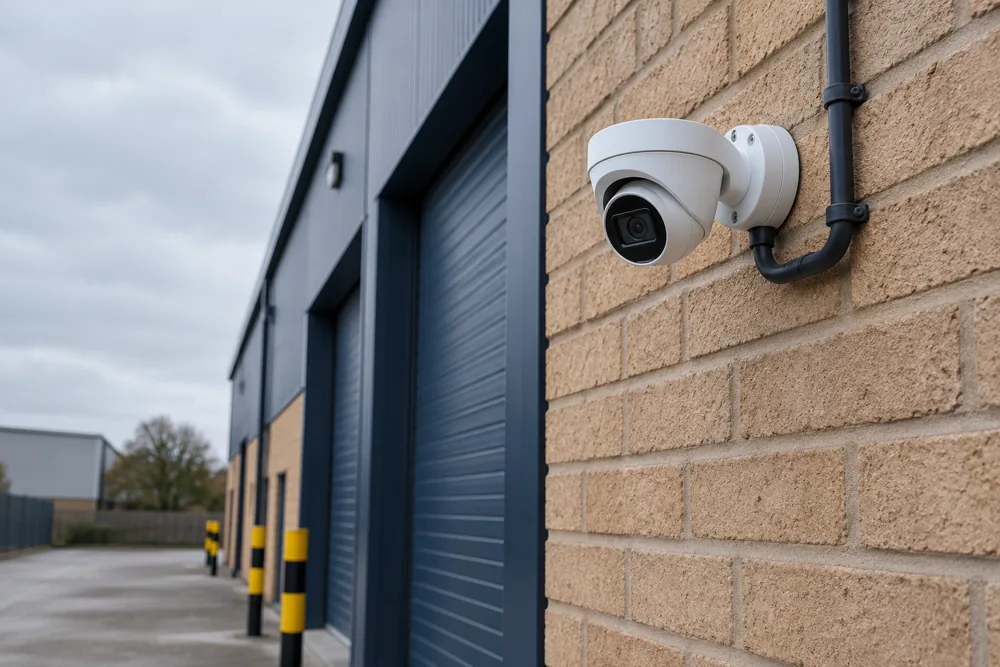
Start With The Operational Requirement
A camera count is not a security specification. Before selecting equipment, identify the events you need to investigate, the objects or people that must be visible and who will retrieve recordings after an incident. An overview of a yard and a usable image of someone entering a stockroom are different tasks.
Our approach to CCTV installation starts with the commercial activity at your premises. Delivery schedules, vehicle movements, opening hours and stock handling all affect camera positions. A camera that gives a good empty-building view may be blocked by a parked trailer during the busiest part of the day.
Choose Cameras For The Actual Conditions
Entrances can combine bright daylight outside with a dark lobby inside. Loading areas may have headlights, reflective packaging and patchy illumination. Camera selection should account for those conditions, with suitable lenses, exposure settings and mounting positions rather than relying on a headline resolution figure.
Night-time performance deserves its own check. Infrared light can reflect from a nearby wall or dirty dome, while a wide view may leave too few usable details at a distant boundary. Where identification matters, agree a practical test scene and assess the resulting recording at the intended location.
Recording, Networks And Permissions
Recording capacity depends on image settings, frame rates, scene activity and the retention period your organisation can justify. Storage should be calculated from the agreed requirement. There is no universal retention period that suits every commercial site, and keeping footage indefinitely creates unnecessary privacy and security exposure.
For networked CCTV, involve your IT contact before installation. Discuss network separation, access permissions, software updates, remote viewing and who owns the administrator account. Remote access should use supported, secure methods, with individual user accounts and stronger authentication where the equipment supports it.
Installation And Handover
First, review the premises and record the coverage priorities. Next, prepare a proposal showing camera locations, recording arrangements, cabling and any work needed from your electrical or IT contractor. Agree exclusions and access arrangements before installation begins, especially in occupied offices or live distribution areas.
After fitting and configuration, test each view, check playback and export a sample clip. Handover should cover user training, administrator access, an equipment schedule and the process for reporting faults. Record the settings that affect retention and image quality so later changes can be reviewed against the original purpose.
UK Guidance And Privacy Duties
The BS EN 62676 series provides a recognised framework for security video systems. Application guidance covers selection, design, installation and testing. Ask which current edition is specified for your project and how the proposed system will demonstrate its agreed operational performance.
UK GDPR and the Data Protection Act 2018 apply when commercial CCTV records identifiable people. The ICO explains purpose, proportionality, signage, access controls and privacy assessment. Your organisation needs a lawful basis and should assess whether a data protection impact assessment is required. Read the ICO video surveillance guidance before deployment.
Pricing A CCTV Installation In Wakefield
The main cost drivers are the number of distinct coverage tasks, camera specification, cable routes, mounting height, network readiness and recording storage. Safe access equipment and installation outside operating hours can also change the scope. Ask for these items to be separated in the quotation.
Existing cameras or cabling may be reusable after testing, but compatibility cannot be assumed. A lower initial quote can leave out training, remote access licences or future maintenance. Compare the full specification and discuss CCTV maintenance before choosing a system.
Your Questions Answered
Can Existing Cameras Be Reused?
Existing CCTV cameras can sometimes be reused if their image quality, condition and compatibility meet the new requirement. The recorder, power arrangements and cable routes also need checking. Share the equipment model numbers if available, but avoid sending administrator passwords or sensitive footage with an initial enquiry.
Can CCTV Read Vehicle Number Plates?
CCTV number plate capture needs a specific design for vehicle speed, angle, distance and lighting. A general yard camera may give useful context without recording legible plates. State whether you need a readable incident image or an automatic number plate recognition function, as those requirements lead to different equipment and privacy considerations.